

By Zahoor Gulzar
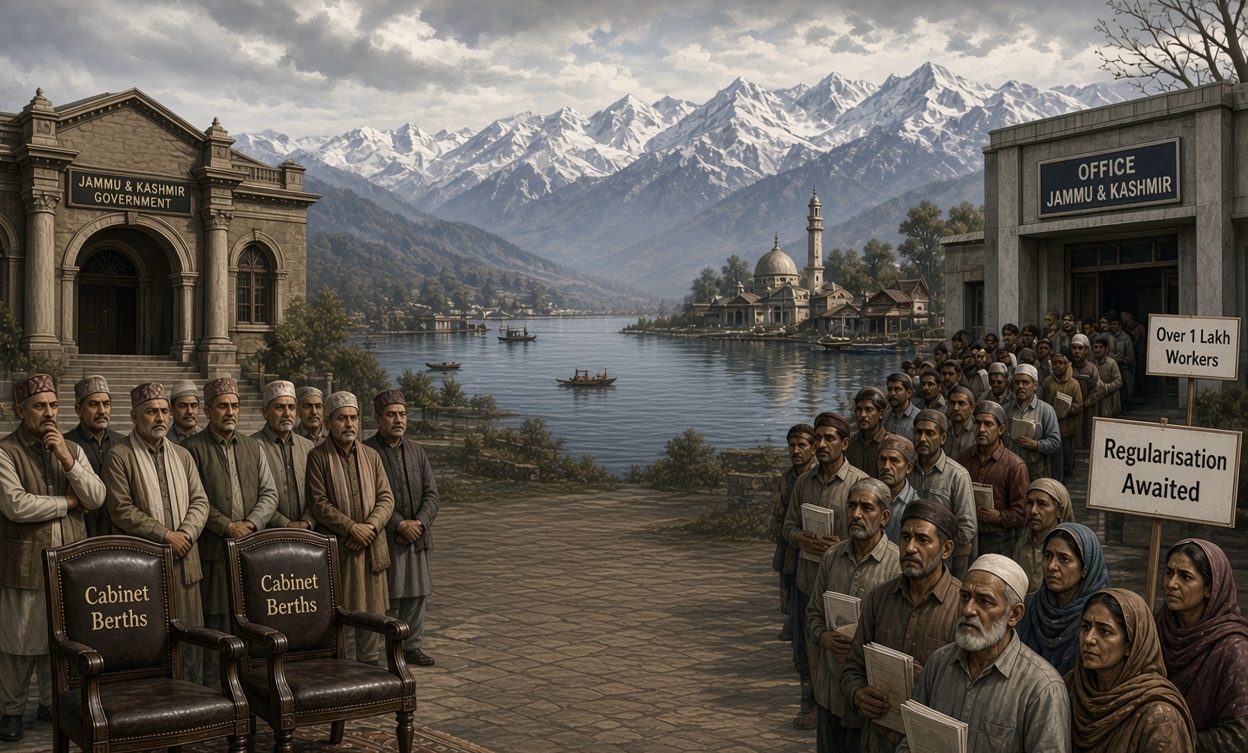
Srinagar: Nearly two years after the National Conference-led government assumed office in Jammu and Kashmir, a dual sense of anticipation grips the political and social landscape. Even as the process for regularising casual labourers and daily-rated workers long promised by Chief Minister Omar Abdullah moves forward in phases, a parallel wait has intensified among National Conference MLAs for the remaining Cabinet berths.
Omar Abdullah was sworn in as Chief Minister on 16 October 2024, along with five ministers: Deputy Chief Minister Surinder Kumar Choudhary, Sakina Itoo, Javid Ahmad Dar, Javed Ahmed Rana, and Satish Sharma. Under the Jammu and Kashmir Reorganisation Act, the Council of Ministers is capped at 10% of the 90-member Assembly meaning a maximum of nine members including the Chief Minister. Three berths have remained vacant since the initial formation.
Recent reports indicate growing restlessness within the ruling National Conference. Several MLAs, particularly from Kashmir, have been lobbying for induction. The Chief Minister has repeatedly signalled that expansion is under consideration, with indications pointing to a possible move after 15 August 2026. Balancing regional representation (Kashmir versus Jammu), accommodating senior leaders alongside first-time legislators, and managing the limited slots has delayed the decision. Opposition voices, including from the BJP, have criticised the prolonged wait, while party insiders describe it as a careful exercise to avoid creating more discontent than satisfaction.
In a striking parallel, tens of thousands of casual labourers and daily wagers continue to await the fulfilment of another key electoral commitment. Official figures place the number of such workers across government departments at over one lakh, including approximately 69,696 casual labourers, along with daily-rated workers, seasonal labourers, and others. Chief Minister Omar Abdullah has repeatedly assured the Assembly that regularisation will begin in a phased, legally and financially sustainable manner during the current financial year (2026). A committee headed by the Chief Secretary was constituted to prepare a roadmap; the government has stated it will not resort to hurried executive orders that risk legal or fiscal challenges.
Abdullah has acknowledged the decades-long struggle of these workers some employed for 20 to 40 years and emphasised that previous governments failed to resolve the issue comprehensively. He has linked the process to a transparent, time-bound framework while simultaneously prioritising the filling of around 30,000 vacant posts through regular recruitment channels.
The simultaneous waits of elected MLAs for ministerial responsibility and of casual workers for job security highlight the pressures on the young government. For the National Conference, expanding the Cabinet offers a chance to broaden representation and manage internal aspirations, yet the limited number of berths means many legislators will remain outside the Council. For casual labourers, the phased regularisation promised by the Chief Minister represents the first structured hope in years of uncertainty.
As August progresses, both groups remain in a state of expectant pause. The timing and composition of any Cabinet expansion, alongside concrete steps on the regularisation policy, will be closely watched as markers of the government’s ability to deliver on governance and political management in the Union Territory.

