

Asiya Manzoor
For many women, menstrual discomfort is considered as a routine part of life. However, when the pain becomes unusually severe, continues to effect daily activities, or repeatedly interferes with studies and work, it may require medical attention, one possible cause is ENDOMETRIOSIS, a conditionthatcontinuestoaffectthelivesofwomenwhileremaininginsufficientlyunderstood.
Endometriosis is a medical condition in which a tissue similar to inner lining of uterus grows outside the uterus, which may affect the areas around the reproductive organs, including the ovaries and other parts of Pelvicregions. This can lead to inflammation, pain and in some cases the formation of scar tissueorcysts.
The condition does not affect every woman (married or unmarried) in same way. Some may experience severe menstrual pain from their teenage years, while other suffer from persistent pelvic discomfort, heavy bleeding, fatigue and difficulty in carrying out routine activities. In some
cases, Endometriosis is discovered only when women seek medical advice related difficulties related to conception, but girls should not wait until marriage or fertility concerns arises before seeking help.
One of the challenges associated with Endometriosis is that its symptoms can vary considerably.
The intensity of pain does not always indicate the extent of the condition. As a result, some women and girls may spend a long time seeking for cause of their symptoms before receiving an appropriate diagnosis. Painful menstrual should not be dismissed as something that girls simply have to tolerate.
For this reason, persistent or unusually severe menstrual pain should not simply ignore. Girls who miss school, avoid activities, require frequent pain medication, experience pain during bowl movement or urination, or feel that periods are disrupting daily life should speak with at rusted adult and seek timely medical advice.
Endometriosis can also have impact on fertility in some women, particularly when inflammation or cysts affects the normal functioning of reproductive organs. However, the condition does not mean that motherhood is impossible. With appropriate medical care and guidance, many women
with endometriosis can plan and achieve pregnancy. For girls, the priority is early recognition, symptom relief and protecting their long-term health-not fear about future marriage or fertility.
Beyond its physical effects, living with recurring pain can influence female’s education, confidence and overall quality of life. Yet because the condition is not always visible, the difficulties by those living with it may not always be understood by parents, teachers or peers. Young girls may also feel embarrassed discussing menstrual symptoms, which can delay diagnosis and treatment.
Example:
Myth:
“Severe menstrual pain is always normal”
Fact:
Persistent or disabling menstrual pain deserves medical evaluation.
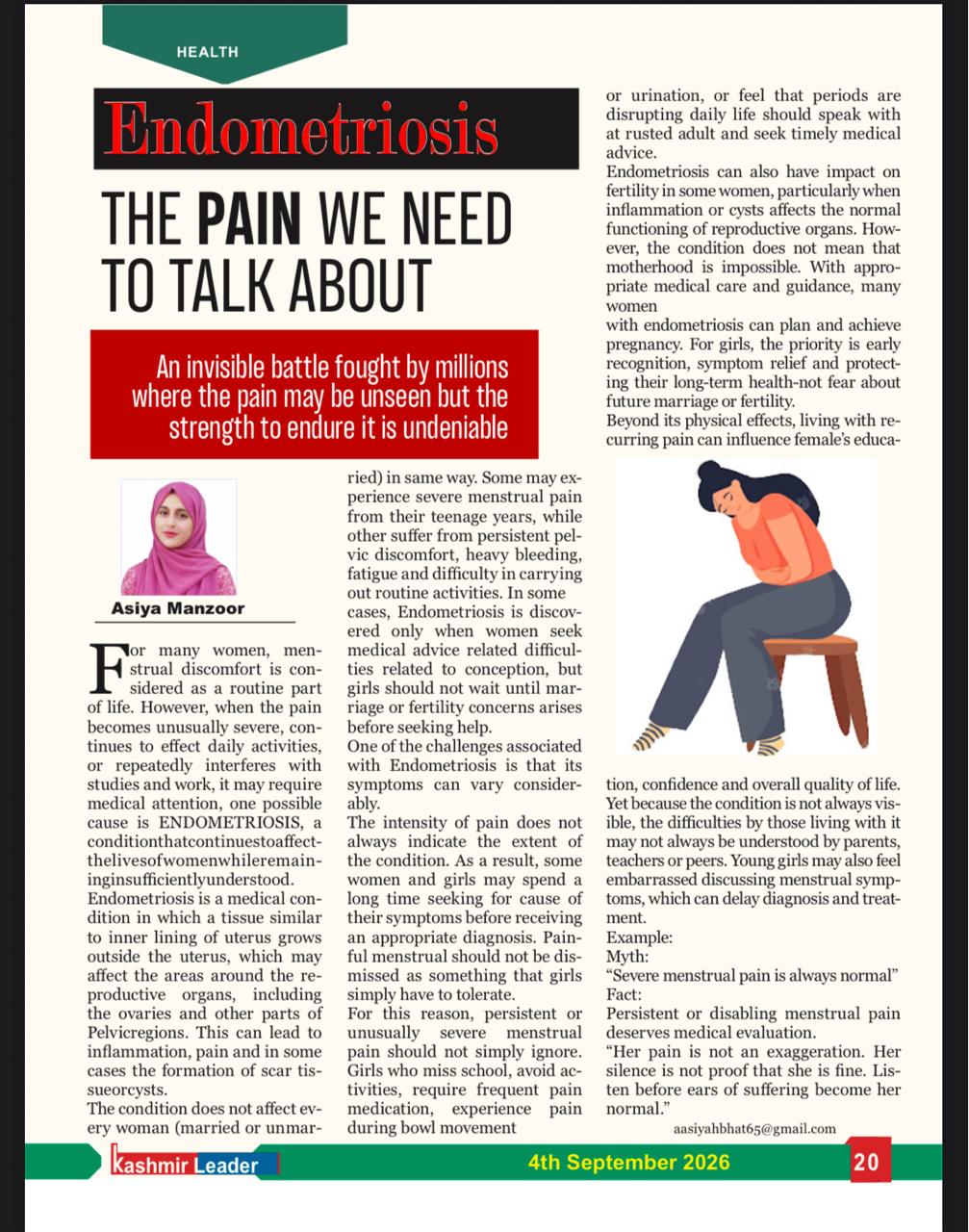
“Her pain is not an exaggeration. Her silence is not proof that she is fine. Listen before ears of suffering become her normal.”

